
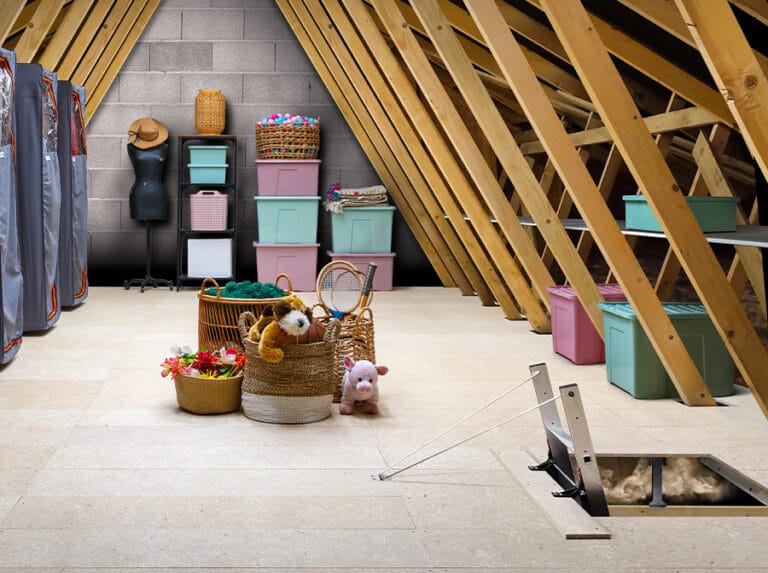

Dave Raval, Director of the National Warm Homes Council, explains why proper insulation, especially in attic spaces, will decide the fate of the Future Homes Standard.
Lofty expectations
The government’s Future Homes Standard promises a new era of energy-efficient, zero-carbon homes. Heat pumps, solar panels and EV charging points dominate the headlines.
But the National Warm Homes Council warns that critical components are being overlooked: proper loft insulation and protecting it from compression.
Without due attention, the FHS risks falling short. Homeowners could pay twice for energy efficiency, and the standard could undermine the very goals it was designed to achieve.
The commercial case for developers
Developers and builders play a pivotal role in delivering future-ready homes. They speed up low-carbon technology adoption, cut household energy demand and help the UK reach net zero.
Building sustainability and usability into developments brings clear rewards. Builders can:
- Boost market appeal
- Differentiate their brand
- Meet rising consumer demand for energy-efficient homes
One space gets overlooked again and again: the loft.
There is real commercial potential in optimising lofts in both existing and new builds. Raised loft boarding does this affordably and easily.
What raised loft boarding delivers
Raised loft boarding protects insulation from everyday storage. It maximises long-term energy savings, cuts emissions and bills, and keeps heat pumps and solar panels working well.
It also gives you:
- Safe access walkways
- Extra storage space
- Higher property resale value
The numbers you need to know
Research from the National Physical Laboratory shows that compressed or disturbed loft insulation loses at least 50% of its thermal effectiveness. Sometimes this happens within months, with matching heat loss.
Around 80% of households use their lofts for storage, according to the Carbon Trust. Preventing unnecessary remedial works is critical to avoid wasted energy and carbon emissions.
The scale of the problem is stark:
Over 13 million homes in the UK still meet only 1976 standards for loft insulation, costing homeowners hundreds of pounds each year in wasted energy.
Delays that threaten the standard
The situation is made worse by a delay of at least three months in the Home Energy Model (HEM). HEM underpins the FHS and replaces the old Standard Assessment Procedure (SAP).
Launching the FHS without HEM leaves builders and homeowners facing uncertainty. Regulations risk becoming high-level promises on paper rather than enforceable standards that deliver measurable results.
Planning permission delays make things harder still. It could take up to ten years for the new standards to be fully realised.
Without urgent action to install and protect loft insulation properly, the FHS may fail to deliver the energy efficiency, net-zero savings and lower bills it promises.
Why the basics still matter most
Attention focuses on advanced systems like heat pumps and solar panels. But compliance, and more importantly actual energy efficiency, still relies on the basics: robust insulation and airtight construction.
In a typical British home, around 25% of heat escapes through the ceiling into the loft. Proper insulation acts like a woolly hat for the house. It traps warmth and reduces the energy needed to stay comfortable.
Insulating a loft is only the first step. Squashing insulation, whether through storage or poor boarding, can sharply increase heat loss.
Fluffy loft insulation works by trapping air. Displace that air and its thermal performance drops fast.
Raised loft boarding preserves the full insulation depth. It lets you use the loft safely and efficiently while meeting FHS requirements and enabling effective energy management.
The bottom line
The FHS represents a major opportunity for the housing sector. Its success depends on attention to detail, and on recognising that energy efficiency begins with proper insulation and airtight construction.
Protecting loft insulation is not an optional extra. It is fundamental to delivering homes that are genuinely fit for the future.
The message is clear. The Future Homes Standard will only achieve its promise if lofts, the most overlooked part of a home, are properly insulated and protected.
Is your loft ready for the future, or is it quietly costing you money right now?