
You’re maybe looking at loft legs because you need storage space above your insulation. These types of vertical leg systems seem straightforward; you screw them onto your joists, attach some boards, and you’re done.
But you’ll spend hours measuring your loft space, drilling 936 screws into a typical 23 square metre loft space. Your drill battery will probably die multiple times. If your joists are unevenly spaced (most are!), then you’ll wrestle with a system that lets boards overhang dangerously or leaves gaps where they should sit securely. Pipes and wiring will force you into awkward positions as you try to place legs on every single joist.
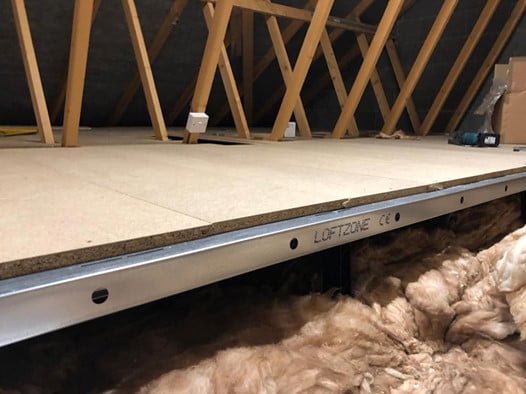
When you need storage above thick insulation, you have four main options: individual plastic legs (like loft legs), rigid foam boards, timber framework, or beam-based systems (like LoftZone StoreFloor). The best solutions are lightweight enough not to stress your ceiling joists, strong enough to handle storage loads safely, and simple enough that you won’t spend your entire weekend swearing at instruction manuals. Most importantly, they must work with conditions such as uneven joists, existing pipes, and awkward wiring routes.
This is where systems like StoreFloor offer a different approach to the same problem.
The Installation Speed Difference Between Loft Legs and StoreFloor
The screw count tells the real story. In a 23 square metre loft (roughly what you’d find in a typical two-bedroom house), loft legs require 936 screws. StoreFloor needs 378 screws for the same area.
That’s 558 fewer screws to drive home.
Each screw takes time to position, drill, and tighten. Multiply that by several hundred and you’re looking at hours of work. Your wrist will ache, your drill battery will need multiple charges, and you’ll find yourself counting down screws.
The difference comes down to how each system works. Loft legs attach individually to each joist, then each board screws directly into multiple legs. StoreFloor uses fewer support points because of their patented cross-beam system. You screw boards into continuous metal beams rather than individual plastic legs.
Fewer screws also means fewer things that can work loose over time.
Handling Obstacles and Uneven Joists
Lofts aren’t perfect; that is just a fact. You’ll find pipes running across joists, electrical cables snaking between them, and joists that aren’t quite straight or evenly spaced. This is where loft legs become genuinely frustrating.
Loft legs must sit directly on joists. When obstacles get in the way, you face several problems:
- Pipes across joists: You can’t move the leg elsewhere because you need that support point, forcing you to work around the obstacle at awkward angles
- Electrical cables: Similar issue where you’re trying to position legs where there’s barely enough flat surface around the wiring
- Limited placement options: Every leg needs a specific spot on a joist, leaving no flexibility when obstacles appear.
StoreFloor cross-beams simply span over these obstacles. A pipe running across your joists? The beam goes over it. Wiring in the way? Same solution. You position the plastic supports on clear sections of joist, then the metal beams bridge across whatever’s in between.
This approach saves time beyond just the reduced screw count. You’re not battling placement issues or finding workarounds for every obstacle. The system adapts to your loft’s layout rather than forcing your loft to suit the system.
Warped or uneven joists create similar problems with individual legs, but cross-beams handle variations in height and spacing without compromising stability.
Safety and Stability Concerns When Installing a Raised Loft Boarding System
Uneven joist spacing creates the biggest safety headache with loft legs. Most joists in UK lofts are 400mm or 600mm apart (measured from the centre of one joist to the centre of the next joist), but most lofts do not stick to this spacing, which is very frustrating indeed! You’ll often find spacing that varies by 20-50mm across the same loft.
With loft legs, this variation creates dangerous situations:
- Board overhang: When joists are closer together, boards extend past the leg, creating an unstable edge that could snap under weight.
- Cutting requirements: Overhang issues also force you to cut boards to size, creating waste and additional work.
- Boards not reaching supports: When joists are further apart, boards may not reach the next leg properly, leaving them resting on just a corner, or not reaching at all!.
- Precarious balance: Boards sitting partially on leg corners will flex and move when you step on them
With uneven joist spacing, you may therefore end up with a patchwork floor where some sections feel solid and others bounce or creak when you walk on them. Not exactly the confidence-inspiring loft storage you were after.
StoreFloor’s Cross-Beams slide along the plastic supports to adjust for joist spacing variations. Your boards always screw into a full beam surface, regardless of how your joists are positioned. The metal beams are strong enough to bridge gaps, so you get consistent support across the entire floor.
Every board sits on the same stable foundation, giving you confidence when moving around your loft.
Why Cross-Beams Make All the Difference in the Loft Boarding Process
The fundamental difference between loft legs and StoreFloor comes down to how weight gets distributed. Loft legs work as individual point loads, each leg carrying whatever weight sits directly above it. If one leg fails or shifts, that section of floor becomes unstable.
Cross-beams change this completely. Weight spreads across the entire beam length, sharing the load between multiple support points. This creates a much stronger overall structure from the same amount of material.
Here’s what this means in practice:
- Fewer weak points: Instead of dozens of individual legs that could potentially fail, you have continuous beams distributing stress
- Better load handling: Heavy items don’t rely on single support points underneath them
- Structural flexibility: The system adapts to your loft’s quirks rather than fighting them
- Long-term reliability: Less stress on individual components means the whole system lasts longer
The cross-beam design also means you’re building a proper raised floor structure rather than assembling lots of separate supports. Each beam replaces multiple individual attachment points, which is why the screw count drops so dramatically.
Your loft deserves better than a collection of plastic stilts.
Other Loft Boarding Options
Rigid foam boards and timber frameworks offer alternatives to both loft legs and StoreFloor. Rigid foam is lightweight but can damage electrical cables with certain chemicals and can cause interstitial condensation owing to the lack of ventilation under the boards, while timber creates thermal bridging issues that aren’t allowed in new builds under current building regulations. StoreFloor avoids both problems while maintaining the strength and adjustability you need for real-world lofts.
Making the Right Choice For Your Loft
Loft legs seem like the obvious choice until you actually start using them. The reality of 936 screws, awkward obstacle placement, and unstable boards on uneven joists makes for a frustrating weekend project that could leave you with a floor you’re not entirely confident walking on.
StoreFloor’s cross-beam system cuts your installation time significantly while giving you a more stable result. You’ll use 60% fewer screws, work around obstacles instead of fighting them, and end up with consistent support across your entire loft floor.
Your loft storage project doesn’t have to be a test of patience and determination. Choose a system that works with your loft’s realities rather than against them, and you’ll have more time to use the storage space you’re creating.
Yes, StoreFloor costs more than basic plastic legs. That’s because of the metal Cross-Beams. But those beams make installation much faster and easier, while creating a safer, more stable deck to walk on. The time you save on installation day alone often justifies the price difference. Check out our StoreFloor kits and use our configurator to work out exactly what your loft needs.